








Product Search Results
%201.svg)
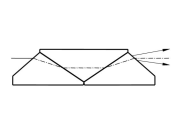
K prisms rhombs generate a phase shift of a quarter wavelength based the phase difference between the s-polarized and the p-polarized component in total internal reflection. Similar to Fresnel rhombs Fresnel-Rhomben the path difference shows only a small variation with the wavelength and the prisms are useable over very broad spectral ranges.


K prisms rhombs generate a phase shift of a quarter wavelength based the phase difference between the s-polarized and the p-polarized component in total internal reflection. Similar to Fresnel rhombs Fresnel-Rhomben the path difference shows only a small variation with the wavelength and the prisms are useable over very broad spectral ranges.
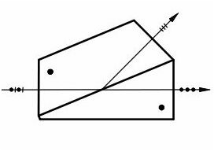
K prisms do not introduce a beam displacement for light on the optical axis. Consequently, the beam position strays constant even if the application requires a rotation of the prism.
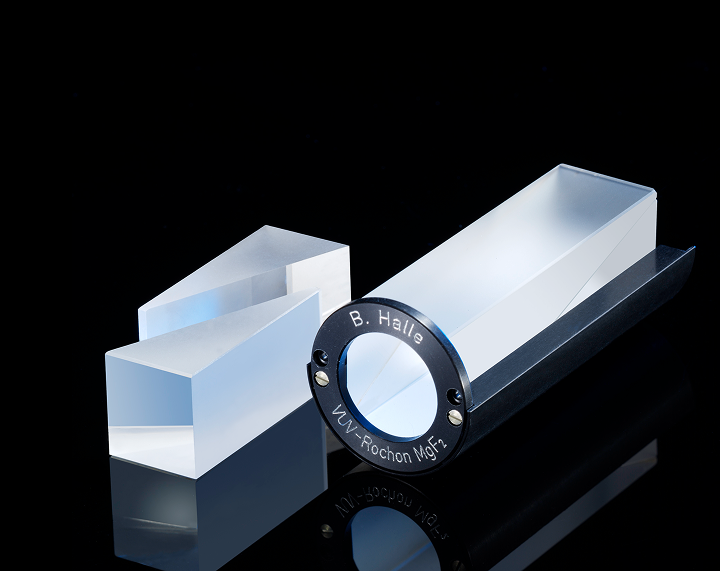
A K prism is assembled from two halves which are connected by optical contact. The contact line between the prisms is located at the center of the clear aperture. The edges of the prisms are not chamfered yielding a hardly visible contact line.
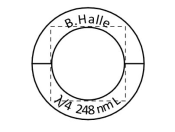
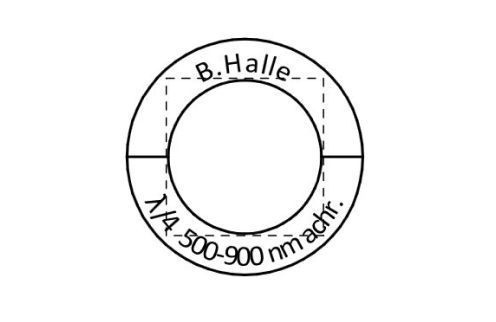
We manufacture K prisms from fused silica and from N-BK7. The prisms are delivered in a cylindrical holder and without antireflection coating.
| Art. No. | RFK 200 | RFK 400 |
| spectral range | 215-1700 nm | 350-2250 nm |
| material | fused silica | N-BK7 |
| deviation of retardation | ±4% | ±2% |
| wavefront distortion | <λ/10 | <λ/10 |
| prismatic deviation | <15'' | <15'' |
| reflectivity | ca. 3,5% | ca. 4% |
| temperature coefficient* a/R0 (typ.) | 10×10-6/K | 2×10⁻⁶/K |
| tilt sensitivity** | max. angle of incidence typ. 1° | |
* Definition ** K prisms are quite sensitive to tilt and show a qualitative difference compared to birefringent retarders. The angular coefficient is not meaningful for K prisms.
| version | 215-1700 nm | 350-2250 nm | |
| Art. No. | RFK 200 | RFK 400 | |
| free aperture | [mm] | 9.5 | 9.5 |
| mount diameter | [mm] | 30 | 30 |
| mount length | [mm] | 92.5 | 92.5 |
| connection diameter | [mm] | 25 | 25 |

For up-to-date prices, please refer to the current price list or request a quote.
| option | order-no. | additional price |
| antireflection coating | --- | on request |
.png)