Polarizers

Polarizers are optical components used to produce a defined linear polarization state from randomly polarized light. They selectively transmit light with the desired polarization orientation, while the orthogonal polarization component is either absorbed or reflected, depending on the polarizer type.

Polarizers available from our catalogue

Below you can find the Polarizers available as catalog items. Click on the respective logos to visit the catalogue pages and explore the products. You can also use the feature filter to identify the type of Polarizers best suited for your application.

Here we show the Polarizers which are available as catalogue items. It does not claim to provide a complete system from which most optical setups can be realized. It is restricted to a variety of high quality parts which simplify the usage of the optical parts manufactured by us. Please click on the different logos to visit the catalogue article sites and check out the different products. You can use the feature filter to check which type of Polarizers suits your application.

Features
Thank you! Your submission has been received!
Oops! Something went wrong while submitting the form.
Glan-Thompson Polarizing Prisms

High Extinction

Broadband

Direct Beam / Undeviated Beam
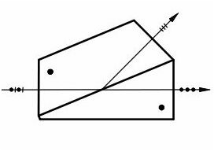
Foster Polarizing Beamsplitters

High Extinction

Broadband

Output for Blocked Beam

Direct Beam / Undeviated Beam

Glan Polarizing Prisms

High Power

Broadband

Direct Beam / Undeviated Beam

Output for Blocked Beam

Wollaston Polarizers

High Extinction

Vacuum UV

Output for Blocked Beam

Aperture > 15 mm Available

Symmetric Extinction for Both Polarisations

Rochon Polarizers

Vacuum UV

Output for Blocked Beam

Symmetric Extinction for Both Polarisations

Polarizing Beamsplitter Cubes

Output for Blocked Beam

90° Beam Exit

Aperture > 15 mm Available

Hanle Wedge Depolarizers

Depolariser

Broadband

Aperture > 15 mm Available

Lyot Depolarizer

Aperture > 15 mm Available

Broadband

Depolariser

Scientific publications that reference to our Polarizers

Here you will find a selection of scientific papers in which our Polarizers have been used. The logos represent the various areas of application in which these can be utilized. You can use the two buttons to access either the publication or the corresponding product.

Glan–Thompson prism

Spectroscopy

PGT

Unusual features of long-range density fluctuations in glass-forming organic liquids: A Rayleigh and Rayleigh-Brillouin light scattering study

Glan polarizing prism

Optical Biomedical Imaging

PGL 10.2

Commercially derived versatile optical architecture for two-photon STED, wavelength mixing and label-free microscopy

Glan–Thompson prism

Polarimetry

PGT

Study of the birefringence noise in high-finesse ULE cavity

Glan–Thompson prism

Ultra short laser pulses

PGT

High Energy Few-Cycle Pulse Post-Compression in a Single Thin-Plate with a Spatially-Uniform Beam Profile

Glan–Thompson prism

Polarimetry

PGT

Study of the birefringence noise in high-finesse ULE cavity

Polarizer

Spectroscopy

PGT

Understanding the relaxation spectra of neat and mixed ionic liquids

Wollaston prism

Ultra short laser pulses

NN

Self-referencing circular dichroism ion yield measurements for improved statistics using femtosecond laser pulses

UV Rochon prism

Polarimetry

PUM 1.08

Corneal absorption spectra in the deep UV range

Glan–Thompson prism

Polarimetry

PGT 2.10

Mueller matrix ellipsometric approach on the imaging of sub-wavelength nanostructures

polarizers

Spectroscopy

PGT

On the intensity of light scattered by molecular liquids—Comparison of experiment and quantum chemical calculations

K-Prism

Polarimetry

NN

Analysis of non-idealities in rhomb compensators

Optically contacted polarizing beamsplitter

Optical Biomedical Imaging

PTW 25 OK

Simultaneous multicolor fluorescence imaging using duplication-based PSF engineering

Glan–Thompson prism

Spectroscopy

PGT

Hysteresis effects at the tilted to nontilted transition in octadecanol monolayers as observed with Brewster angle autocorrelation spectroscopy