








Product Search Results
%201.svg)

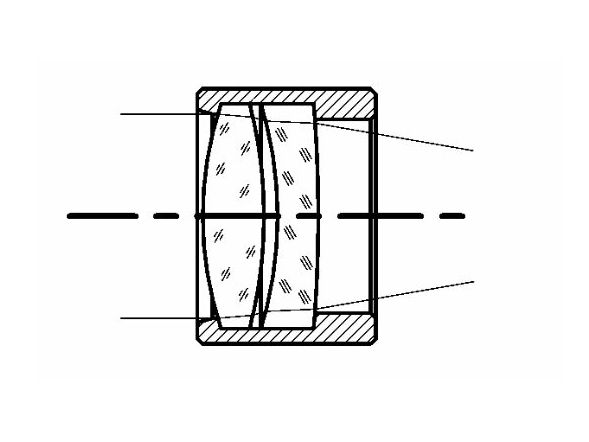
The lenses for these objectives are manufactured from synthetic fused silica and CaF 2. They are assembled with air gaps without cement. The objectives are characterized by a good UV transmission down to 190 nm and achieve diffraction limited performance for small field angles and optimal focusing. The lenses are suited for simple imaging applications. In cases with higher demands on aperture size and imaging quality we recommend to use our objectives for (UV cameras).
We offer objectives with different aperture ratios in versions with two or three lenses. The version with two lenses has an aperture ratio of f:10 and is optimized for infinite object distance (i.e. for focusing of parallel beams, magnification ß' = 0).
The version with three lenses has an aperture ratio of f:4. It is available with optimization for infinite object distance (ß' = 0) as well as for 1:1 imaging (ß' = -1).
TRansmission and chromatic Aberration
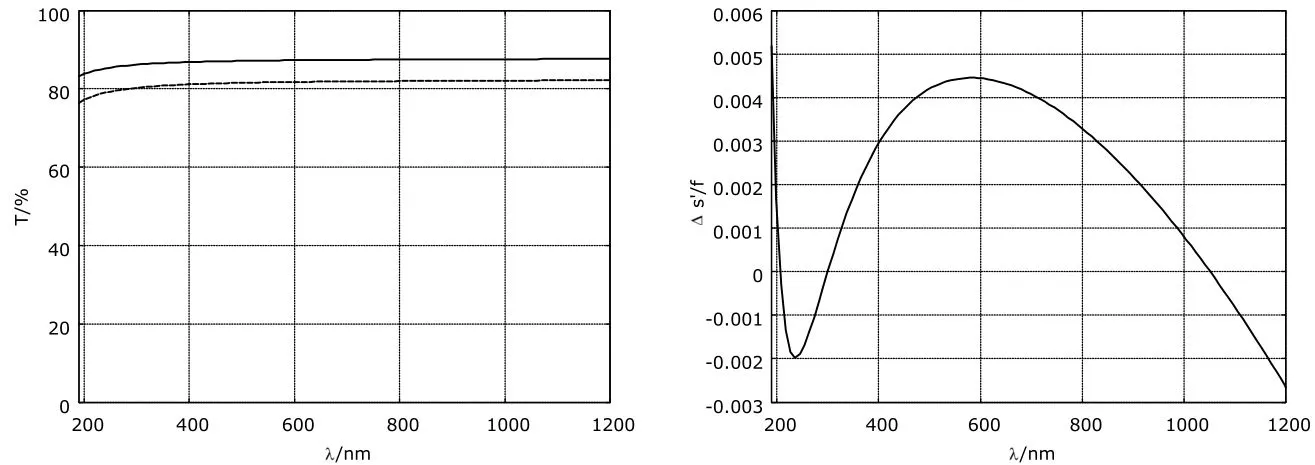
The lens materials are virtually free of absorption in the range 190-2200 nm. The transmission is therefore limited by the reflective losses on the uncoated surfaces. The left diagram shows the transmission of a two lens system (solid line) and a three lens system (dashed line), respectively.
The chromatic focal shift is achromatic in the UV and apochromatic in the wavelength range of 190-1200 nm (UV-VIS-IR). The right diagram shows the typical variation of the back focal length (s’) referenced to the nominal focal length. To calculate the actual focal shift in length units the values must be multiplied by the nominal focal length of the regarded objective.

Hubertusstraße 10 | D - 12163 Berlin
|
.png)