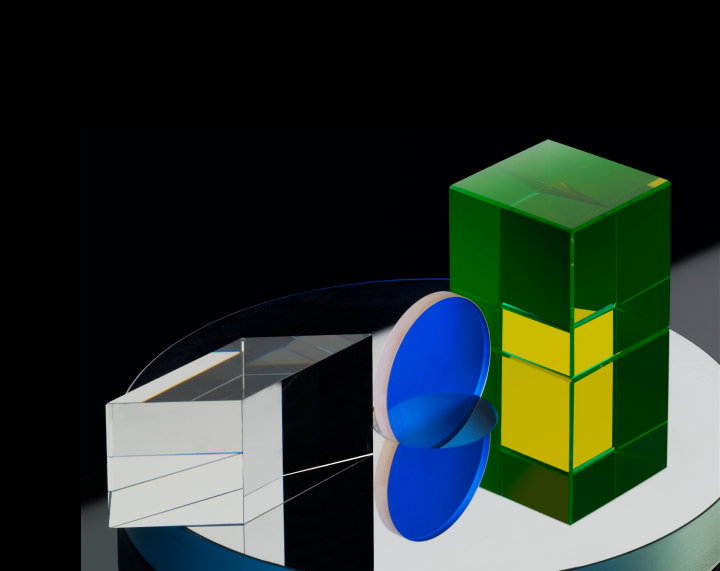
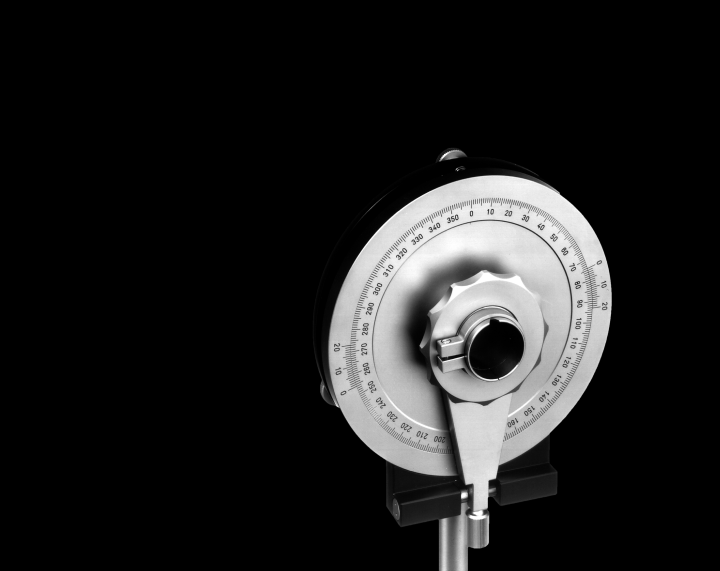
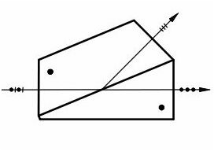
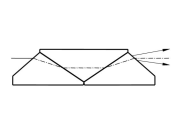
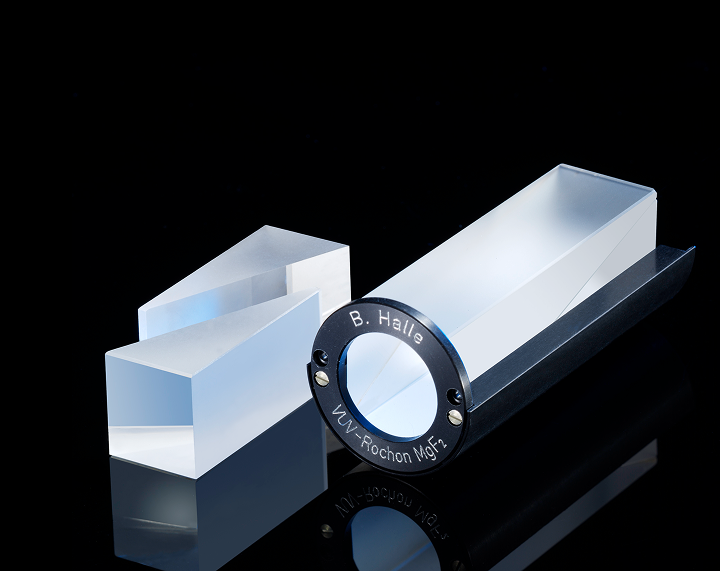
Die Rochon-Polarisatoren bestehen aus zwei identisch geformten Prismen aus doppelbrechendem Magnesiumfluorid (MgF).2). Die Kristallachse ist in einem Prisma parallel zur Ausbreitungsrichtung und in dem anderen senkrecht dazu. Daher wird der außergewöhnliche Strahl beim Durchgang gebrochen, während der normale Strahl bei allen Wellenlängen ohne Abweichung hindurchgeht. Aus diesem Grund eignen sich Rochon-Polarisatoren besonders für Anwendungen, die einen rotierenden Polarisator erfordern. Die Polarisation des normalen Strahls verläuft parallel zur Teilungsebene.
Wir liefern die Prismen standardmäßig mit einer zylindrischen Halterung und ohne Antireflexbeschichtung. Die Halter sind völlig zementfrei und eignen sich daher für Vakuumbedingungen.
Wir bieten Rochon-Polarisatoren mit drei verschiedenen Spaltwinkeln an. Die Version mit einem Spaltwinkel von 0,5° ist mit einem Luftspalt zwischen den Prismen ausgestattet. Diese Version eignet sich sowohl für hohe Laserleistungen im UV-Bereich als auch für Anwendungen mit erhöhter thermischer Belastung. Die Innenflächen sind im Brewster-Winkel geschnitten, wodurch die Reflexionsverluste des normalen Strahls auf diesen Oberflächen minimiert werden.
Bei den Versionen mit Spaltwinkeln von 2,5° und 4° sind die erforderlichen Schnittwinkel größer und würden eine totale interne Reflexion an einem Luftspalt bedeuten. Daher sind die Prismen durch einen zementlosen optischen Kontakt miteinander verbunden.
Optical specifications
Divergence angle
0,5°
2,5°
4,0°
material
MgF2 VUV quality
spectral range
150-6000 nm
extinction ratio
10-5
wavefront distortion
<λ/5
prismatic deviation
<3’
cut angle
34,0°
73,5°
80,3°
connection of the prisms
air gap
optical contact (no cement)
Optical specifications
format
10 mm
15 mm
Article-No.:
PLM 10
PLM 15
free aperture
[mm]
9,5
14,5
Length
[mm]
11
13
mount diameter
[mm]
25
25
mount length
[mm]
16
20
Prices
For up-to-date prices, please refer to the current
price list
or request a quote.
Optical specifications
format
8 mm
10 mm
12 mm
15 mm
Article-No.:
PUM 1.08
PUM 1.10
PUM 1.12
PUM 1.15
free aperture
[mm]
8
10
12
15
Length
[mm]
29
36
42
52
mount diameter
[mm]
25
25
25
25
mount length
[mm]
38
45
53
57
Prices
For up-to-date prices, please refer to the current
price list
or request a quote.
Optical specifications
format
8 mm
10 mm
12 mm
Article-No.:
PUM 2.08
PUM 2.10
PUM 2.12
free aperture
[mm]
8
10
12
Length
[mm]
50
62
74
mount diameter
[mm]
25
25
25
mount length
[mm]
60
72
84
Prices
For up-to-date prices, please refer to the current
price list
or request a quote.
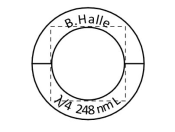
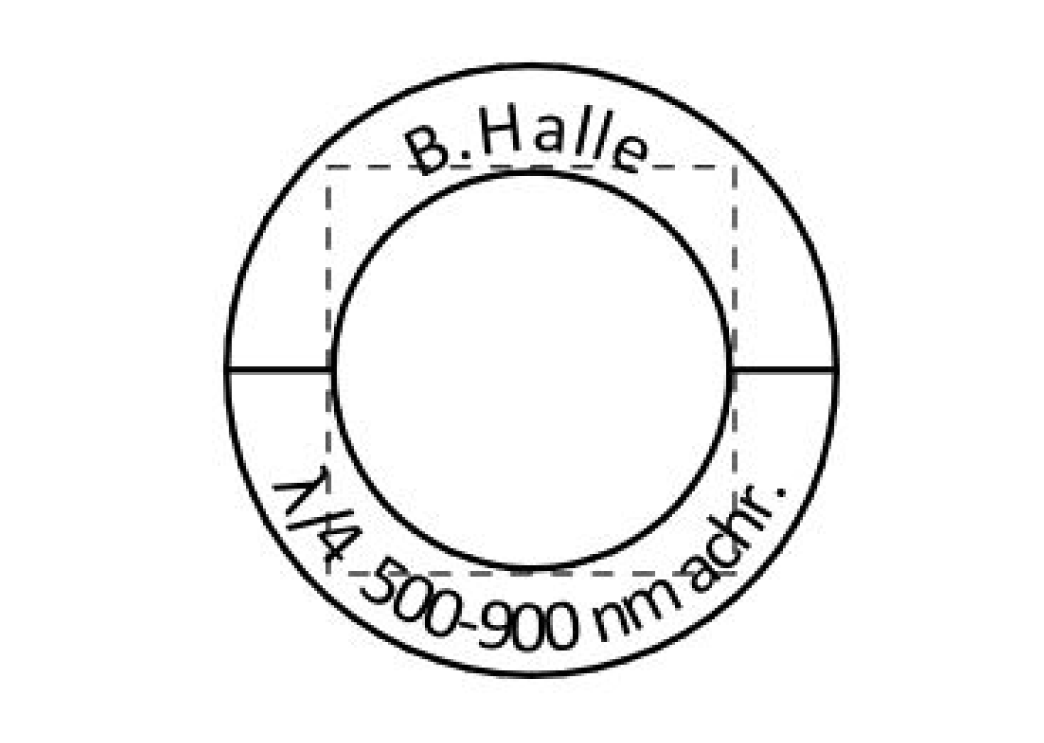
n the prism having the axis direction parallel to the propagation direction (left side in the sketch) the material ideally does not show birefringence. However, small deviations of the propagation direction (e.g. due to tolerances of integration or divergent light) cause the material to become birefringent. The resulting change of polarization can act as an apparent depolarization which limits the observed extinction ratio. The other half of the prism having the crystal axis perpendicular to the propagation direction does not suffer from this effect. This side is always set towards the engraved side of the holder.
If used as a polarizer (i.e. to generate polarized light after the prism) the light should enter from the non-engraved side of the holder. If used a analyzer (i.e. to analyze the polarization state of the incident light) the engraved side should be oriented towards the incident light. Thus, when used in a pair as polarizer and analyzer the engravings of the holders must face each other.
We use cookies to analyze website traffic with Matomo. Data is anonymized to protect your privacy.
Privacy Policy
We value your privacy. Here's how we handle data:
We only use cookies for anonymized traffic analysis via Matomo.
Our cookies do not collect personal or sensitive data.
We track regional activity to improve website performance.











%201.svg)


.png)